California Takeing Away From Art Programs Arts Program Budget
 Credit: Allison Shelley for American Educational activity
 Credit: Allison Shelley for American Education
Louis Freedberg
Jan 12, 2022
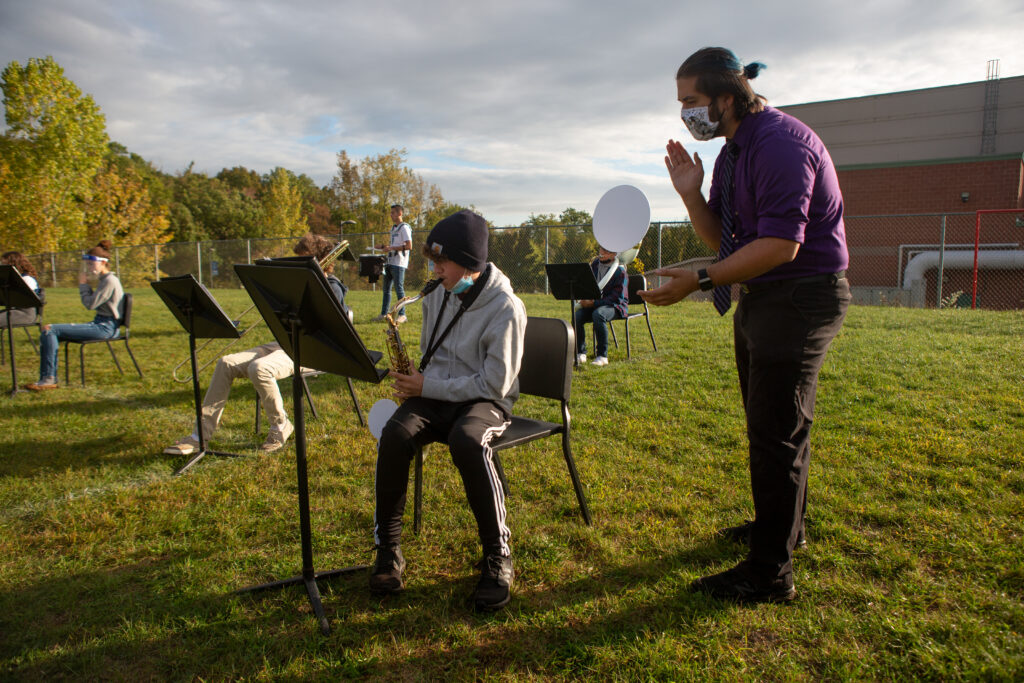
For decades, arts and music education in California has been dying a slow death in many schools, strangled by budget cuts amid an ongoing emphasis on cadre subjects like reading and math and test scores as the measure of pupil success.
Simply now, as educators search for new strategies to excite students nigh learning, especially during this grim pandemic, there is hope for their revival.
In contrast to several proposed ballot measures that would weaken public schools, former Los Angeles Unified Superintendent Austin Beutner is leading an effort to restore arts and music education to a more prominent place in the schoolhouse curriculum.
With the backing of a growing number of artists and educators, Beutner wants to put an initiative on next November's election that would require the state to spend between $800 one thousand thousand and $1 billion actress each year out of its general fund for arts and music pedagogy in the country.
That's iv times more the total upkeep of the National Endowment for the Arts.
A huge windfall for the schools?
Hardly. It's only the equivalent of about 1% of what the country currently on its schools required by Proposition 98, the initiative that dictates how much the state must spend on schools.
This week, the cause of arts and music educational activity got a heave when Gov. Gavin Newsom included $1 billion for that purpose in his Expanded Learning Opportunities Plan for the coming school yr.
As welcome as that funding would be, it is one-time funding, so there is no balls the programs would continue. Nor would they be integrated into the curriculum, just rather would exist part of after-school or summertime programs for K-6 students, and not attainable to all children.
That's why the initiative Beutner is promoting will yet be needed. In fact, it would simply help schools follow the spirit, if non the alphabetic character, of what they are already required to do by police.
Information technology volition come up as a surprise to many Californians — every bit information technology did to me — that state police force really requires schools to provide, from first through sixth grade, "instruction in the subjects of trip the light fantastic toe, music, theater, and visual arts, aimed at the development of aesthetic appreciation and the skills of creative expression."
As for middle and loftier schools, the law is even more prescriptive, saying schools "shall offering courses" in those subjects.
But these laws are weak in the extreme: They don't specify how much pedagogy or how many courses should exist offered, or past whom.
"It mandates information technology, but there are no teeth to information technology," said Li Ezzell, an elementary school art teacher in the San Juan Unified School Commune near Sacramento who just stepped downwardly as president of the California Art Education Association.
The saving grace is that the University of California and the California State Academy both require that students accept the equivalent of a yearlong course in the visual and performing arts for access.
That's better than nothing, only it'south totally inadequate, says Ezzell. "How can you perchance say students take achieved some level of competency (in the arts) when they should have had 12 or thirteen years in it, as they practise in language arts, mathematics and to some degree in science and social studies?"
So what we have now in California is tremendous variation in how much arts and music teaching is offered, as this map of arts programs in California powerfully demonstrates.
Berkeley Unified, where my children went to school, has a vibrant music program offered to thousands of its students starting time in the tertiary grade. It'south just possible because of a parcel tax on real manor approved by the required two-thirds vote of Berkeley voters.
Only a fraction of districts are able to raise that kind of money, and very few in poorer communities. As a result, schools serving low-income students, especially students of color, are less probable to have robust arts programs, notes Pedro Noguera, dean of the University of Southern California'south Rossier School of Educational activity.
Beutner'south initiative, he said, would correspond "an important pace in addressing the upshot."
The disparities are far as well big. National data from a decade agone showed that white students were twice as likely as Black and Latino students to have received an arts education.
The state of affairs is worse at present considering many upkeep cuts fabricated during the Great Recession have non been restored fully, if at all, further eviscerating many programs.
Listen to the travails of Eloy Adame, a trumpeter, arranger and longtime music instructor who is starting an instrumental music program from scratch at the Elizabeth Learning Center, a Los Angeles Unified school with one,500 virtually entirely depression-income Latino students. Near all the students qualify for free or reduced-priced meals. A large challenge is that the school but has 45 instruments for the 200 students in the plan. Some instruments are in need of repair.
Before the pandemic, students would go their own mouthpieces and so share trumpets, for example, or get their ain reeds and share clarinets. The pandemic has concluded that practice. Adame says he needs as much as $90,000 merely for instruments — and getting that kind of coin out of school administrators is "inconceivable."
"They're more than likely to say, 'Can you make it with work with x% of that?'"
This is not merely a California problem but besides a national one. This fall, a commission appointed by the American Academy of Arts and Sciences issued a "call to action" in its report titled "Art's for Life's Sake: The Example for Arts Education."
"Arts education was already in a state of crisis and dire demand before the fraught year of 2020, and the pandemic has intensified that crisis exponentially," the written report asserted.
John Lithgow, a multiple honor-winning thespian who lives in Los Angeles, is a co-chair of the committee and is backing the California initiative.
"I can just talk from my own personal experience, but I'm sure it's true. It just enlivens the unabridged experience of didactics," Lithgow said, referring to the arts classes he took as a student. "Information technology fabricated me want to go to schoolhouse, and it helped me figure out who I was."
That echoes why rap artist and producer Dr. Dre is also on lath.
"I'g all in on giving kids more than access to music and arts pedagogy because creativity saved my life," he said. "I want to practise that for every child in California."
•••
Louis Freedberg is a past executive managing director of EdSource and a veteran education announcer.
The opinions expressed in this commentary correspond those of the author. EdSource welcomes commentaries representing diverse points of view. If yous would like to submit a commentary, please review our guidelines and contact united states.
To get more than reports like this 1, click hither to sign up for EdSource's no-cost daily electronic mail on latest developments in instruction.
Source: https://edsource.org/2022/addressing-the-crisis-in-arts-and-music-education-in-california/664798
0 Response to "California Takeing Away From Art Programs Arts Program Budget"
Post a Comment